Revolution INKJET

Revolution of Inkjet Printing

One Nevertheless, despite the industry’s consistent job growth, shifting consumer demands have created a great deal of disruption, leading many companies to think about incorporating inkjet technology into their digital transformation plans.

The printing market’s prospects

Shorter print runs, cutting-edge technology, and increased product personalization are all expected to shape the printing industry’s future. The global printing industry will spend the next ten years adapting to print buyers’ needs for shorter and faster print runs, according to Smithers’ 2021 market forecast. In addition to changing the dynamics of print costs, this will put further pressure on companies to automate their print manufacturing processes in order to boost profit margins and stay competitive.

Making the switch to an automated process can occasionally be expensive and time-consuming, but the investment is worthwhile. New machinery, such as digital (inkjet and toner) presses, will support the push for more variety in packaging print and assist companies in reducing run lengths. Higher output quality, quicker operating speeds, lower inventory overhead, and several financial advantages result from this.

The revolution of inkjet

Although there are a number of reasons for the growing interest in production inkjet technology for commonplace document applications, the primary forces behind its adoption are significant advancements in ink technology and pre-coat fluids as well as outdated business models that aren’t viable in the current environment.

The key to securing future business success is inkjet technology, which provides a number of features that unlock productivity and efficiency throughout the print production process. Additional advantages consist of:

Better quality: digital color toner presses are less efficient than high-speed inkjet technology. For instance, the high-speed inkjet technology from Konica Minolta can print at rated speed with a resolution of 1200 x 1200 dots per inch (DPI). Higher resolution and little to no warm-up time allow it to print smoother, finer details.

Excellent flexibility: Although flexible packaging accounts for a substantial portion of the packaging market, there are a number of issues with it, such as issues with food safety and de-inking capabilities. There is no requirement for specialized materials because inkjet technology can print on common offset print paper. Along with being suitable with a wide range of packaging materials and substrates, it also provides faster and easier customization than traditional off-set or toner-based print manufacturing.

High productivity: The high-speed UV LED inkjet technology from Konica Minolta can print 1,500 sheets per hour for perfecting and 3,000 sheets per hour for simplexing. By supplying information and quality at faster production speeds, this raises corporate productivity levels and makes the entire print process more cost-effective.

Revolution Of inkjet


Inkjet printing for commercial manufacturing is the way of the future.

Over the next ten years, the commercial print sector will be shaped by data-driven personalization, faster turnaround times, and lower run lengths. A key component of this future is production inkjet technology, whose development as a cutting-edge technology is raising the bar for the print industry’s efficiency, cost-effectiveness, and long-term success.

At Konica Minolta, we are aware of how difficult printing may be and how new technologies will influence future commercial success. We offer creative and distinctive solutions that offer exceptional flexibility, added value, and superior quality to make sure print firms prosper in a digital environment. Modern Konica Minolta print heads and sensing technologies are used in our ground-breaking UV LED inkjet technology, which offers the best speed and quality.

Environment

Advancing the Environment Friendly Digital Print and Decoration Revolution

The commercial printing sector is changing quickly and moving steadily in the direction of more creative and effective solutions. More and more companies are implementing printing solutions that enable them to increase production without sacrificing cost effectiveness.
Digital printing solutions have become more popular as a result of technological improvements, giving companies of all sizes greater control over their printing requirements. Businesses may now print in more complex and creative ways because to digital printers’ ability to manage print runs across a variety of substrates, including folding cartons, pouches, pillow boxes, wooden packaging, and more. This is crucial for the e-commerce sector in order to produce visually appealing packaging that draws in customers.
The boom of e-commerce has led to a significant expansion in the field of digital label and package solutions (L&P). Companies want to be able to generate attractive labels and packaging whenever they need to. However, growing worries about sustainability and the environmental impact of complex packaging also hinder e-commerce enterprises and many others.

The argument in favor of environment friendly printing

Businesses are being forced to modify their operations and make investments in more ecologically friendly solutions as a result of the growing demand for sustainability in consumer behavior. Given the misconceptions about the paper-making process and its effects on the environment, such as the idea that paper is generated more from waste materials than from freshly cut trees, the printing sector as a whole is a major source of worry.

Both reality and public image are being improved by the growing use of sustainable, renewable, and recyclable materials as well as automation and digital printing technologies. According to the paper, because digital printing uses less energy and has a lower overall carbon footprint than outmoded, analogue printing processes, it offers a significantly more favorable solution.

DigitalPirnt

A few years ago, Konica Minolta introduced the IQ-501 (Intelligent Quality Optimiser) to solve waste caused by printing and setup problems. Owners and operators have benefited from this built-in technology as it speeds up setup and increases print efficiency.

According to the survey, digital printing solutions improve sustainability by producing less waste than its more conventional printing equivalents and lowering the need to store and store printed goods and raw materials. Furthermore, the ability to print on demand enables companies to guarantee that the designs they produce are up to date, removing the need for unnecessary, antiquated packaging that is either pulped or dumped in a landfill.

DigitalPrint

Konica Minolta has sustainability front-and-centre and is committed to evolving its digital printing ecosystem to deliver more sustainable and environment friendly solutions.

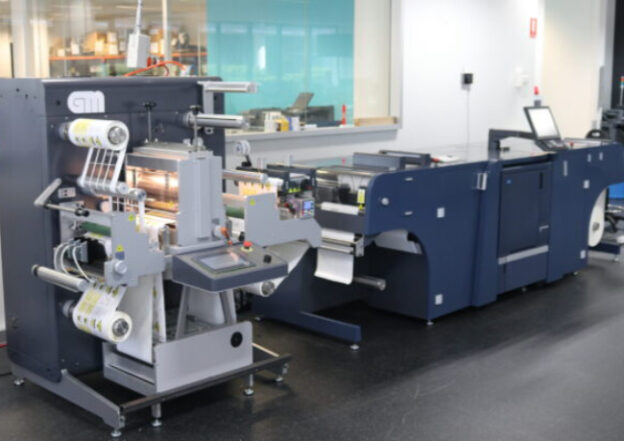
The AccurioLabel and AccurioPro Flux Label Impose-related software are part of Konica Minolta’s label printing portfolio, which helps companies use automation and cutting-edge technology for more environment friendly labeling and packaging. Businesses can customize their printing on demand and cut expenses and waste with the AccurioLabel solution.

Visit AccurioLabel 400 to learn more about how Konica Minolta and the AccurioLabel solution may assist you in providing your company with more environment friendly labeling and packaging.

print

How to make a print more valuable

Businesses that sell luxury or high-end products cannot afford for their marketing collateral to look anything other than spectacular. In addition to having outstanding writing, design, and photography, these organizations require printed materials that are distinctive in a crowded market. This gives commercial and industrial printers the chance to enhance the print tasks they do and opens new growth prospects.

Printed materials are still useful even though a large portion of marketing has moved to digital platforms. The noise produced by so much internet communication can actually be broken up by a well-printed document. Additionally, shorter print runs, customized marketing materials, and quicker work turnaround times are now feasible due to the growing popularity of digital printing.

Four strategies to make print jobs more valuable
Printers may increase their clientele, provide higher-quality work, and possibly even find new markets or revenue streams by adding value to print projects. Here are four strategies to make print more valuable:


1. Inkjet technique using UV LEDs
In addition to being ecologically friendly, UV LED inkjet technology dries incredibly quickly. Because of the quick turnaround times and the fact that inks don’t have time to bleed into the media, the final product is brighter and clearer and free of any flaws or waviness that could be brought on by heaters or dryers.

This is a cost-effective method because it can be printed on regular offset medium and eliminates the requirement for specialized materials. Additionally, short-turnaround assignments become much more feasible with machines that can print 3,000 sheets per hour simplex and 1,500 sheets per hour perfection.

Additionally, inkjet technology provides all the advantages of digital printing, including high productivity, workflow automation, personalization, and agility. Additionally, it enables printers to provide more cheap short-run tasks in greater number. This makes it perfect for books, periodicals, marketing materials, direct mail, and more.

Prints Job


2. Using foils and coatings for embellishment 
Products can be made to stand out by embellishing prints with foils and other coatings, particularly on labels or marketing materials. This evokes a feeling of elegance and quality through a tactile and visually striking experience. Digital finishing, such as heightened effects and foil, can significantly increase value.

Selecting a press that can decorate across a variety of surfaces and toner, inkjet, and offset prints is crucial. Spot gloss, three-dimensional printing, and metallic effects may now be achieved by printers

at a fraction of the time and expense of earlier methods thanks to new haptic, digital varnish technology. An average brochure, label, or mailer can be instantly transformed into something more captivating by adding these decorations and unique touches.

Customers find digital varnish technology to be a very appealing alternative due to its great productivity and quick turnaround, even for intricate embellishments. Additionally, because of the high-end output, printers are able to charge more for these services.

3. Printing at high resolution on the majority of substrates.
For high-value printing, presses with real 1,200 x 1,200 dots per inch (DPI) resolution are perfect because they guarantee accurate reproduction of even tiny text. You can offer countless innovative print applications with a press that has built-in technology to help create a wide color gamut. Additionally, being able to print on a variety of substrates can add value for customers with particular needs. By doing this, printers may be able to reach new customers by providing greater choice and variety.

4. Printing and finalizing labels
Customers also benefit from the ability to provide economical and effective label printing and finishing. It allows printers to serve as a one-stop shop and increase their portion of the customer’s budget by eliminating the need for them to visit several printers for their different needs.

Modern industrial label presses provide flexibility and great productivity by combining intelligent software with effective hardware to produce excellent quality. Adding label printing and finishing to their product line might help printers draw in more clients and possibly increase their profit margins.

The ideal press for the position 
Our goal at Konica Minolta is to assist commercial and industrial printers in increasing their profit margins, creating new sources of income, and taking advantage of new opportunities. Konica Minolta helps printers provide value for their clients, embrace the newest technologies for better results, and optimize workflows for increased efficiency with industry-leading presses that provide outstanding return on investment (ROI).

Production

AI Simplifies Production and Digital Printing

AI will eventually streamline an increasing amount of human labor, such as verifying print output systems. All things considered, AI makes employment safer and more effective. Additionally, there is a lot of room for cost reductions when it comes to purchasing production and professional print materials. What does AI already do for print shops now, and what are the potential future developments?

A Definition of Artificial Intelligence, Machine Learning, and Deep Learning

All three phrases are actually linked.

Machine learning and deep learning techniques are used to create artificial intelligence. The ability of robots to learn and adapt without human assistance is what gives them the appearance of “intelligence.” Although the fundamentals are not new, a new science has emerged as a result of increased access to big data sets and declining high-performance computing costs. Artificial intelligence is mostly influenced by two sources:

Algorithms are used in machine learning to “learn” from data, including photographs. In order to categorize subsequent photos at a higher volume, machine learning typically requires human interaction through manual tagging of sample images. A model is created to forecast the possibility of an image match from a data feed after a human annotates photographs so that the computer can identify important aspects. Analyzing the contents of a complicated visual scene or facial recognition are two instances of the application of machine learning. A relatively modest data set can be quickly transformed into a data model using machine learning.

A subset of machine learning is called deep learning. Essentially, deep learning creates the identification model automatically rather than requiring human interaction to tag data in order to identify text, voice, or image features. Building the models takes a lot longer and calls for considerably larger data sets. “Neural networks,” which are designed to replicate how humans learn and adjust to new information, are frequently used. Deep learning is capable of identifying tasks in addition to data items like photos. For this reason, this technology becomes crucial for operations that involve a lot of processes. Intelligent automation of software systems and physical systems, like robot arms, is possible for the tasks that are a part of daily operations.

Starting with fundamental intelligence for print operations, Konica Minolta employs all three components in different degrees of intelligence and sophistication throughout its range.


The advantages of AI for print companies
Manufacturing workers’ lives are being made easier by AI, which is now being utilized to make the working and manufacturing environment safer and more dependable.

By automating processes, AI helps print firms save labor expenses. AI also makes it possible to plan resources more effectively and accomplish sustainability objectives more successfully. More remote control capabilities and round-the-clock operation for improved press utilization, together with well-planned maintenance, will be available to printers.

Sensible fixes from Konica Minolta 

DeepLeaning

Intelligent algorithms that minimize print waste during the production print process and identify various document layouts. Customized mailings with varying content based on a customer’s profile can be automatically generated for direct mail and catalogs. This method is less prone to errors and more efficient thanks to AI. Because intelligent software can keep track of which presses are busy and which are not, it can route new jobs to available presses directly when it comes to job submission. Self-monitoring presses use a variety of sensors to continuously check on themselves. Algorithms can make real-time adjustments based on data, such as adjusting image quality and paper orientation. Without human involvement, the output is the finest print quality imaginable.

Konica Minolta can receive press operational data immediately. Using tools and algorithms, specialized experts will analyze press data and compare it to the anticipated performance. After that, a technician can determine and suggest software modifications or updates. Even before there is a service outage or disruption, predictive analytics can detect service requirements and start maintenance.

With robust and automated adjustments for image position, registration, and absolute color control—including hybrid color measurement and real-time correction for print output—Konica Minolta’s Intelligent Quality Care (IQ-501) saves time during printing. You can quickly build new and varied print goods with Intelligent Quality Care.

Additionally, issues with individual print jobs can be automatically detected and fixed while printing is underway, eliminating the need for human intervention. This addition greatly streamlines the printing process.


Prospects for AI in Production Printing 

The evaluation of an object’s output quality, especially that of its surface or edge, is the next domain in which artificial intelligence is used. For instance, camera technology linked to a quality inspection system can evaluate the accuracy of cuts made during the post-printing process. Here, artificial intelligence (AI) can be used and learn continuously, replacing some of the manual chores that people perform, freeing them up to work on more lucrative projects.

The manipulation of materials by networked robots is another example of the future. AI may, for instance, determine how long a print job will take and how much paper will be used, and then schedule reloading appropriately, transporting the appropriate supplies from a store to the machine’s side for human handling. Robots are being studied for in-line paper loading; the primary difficulty is precise alignment with huge printer loading bays.

A third field is the application of artificial intelligence (AI) such as ChatGPT to enhance communication and, for instance, swiftly access and utilize technical knowledge currently found in manuals and documentation. Today, Konica Minolta is able to offer its clients increasingly advanced AI technology. Hardware for the IQ-501 Intelligent Quality Care solution’s automatic quality inspection and correction features as well as AI systems linked by the Internet of Things, including industry-standard collaborative robot arms, are examples of solutions. Additionally, camera systems can automatically analyze environmental factors like heat or moisture and monitor workplace health and safety hazards brought on by people, equipment, or environmental factors

These IoT technologies can also be combined by Konica Minolta to produce fresh, useful information for the printing sector and production printing settings. As an end-to-end solution, we are also focusing on combining prepress, press, and postpress technologies. Connecting the dots to minimize manual touchpoints in accordance with Industry 5.0 principles is our goal.

  • Safer places to work
  • A more dependable manufacturing setting
  • Better, automated decision-making through the integration of data from several sources
  • Quicker decision-making
  • Error reduction
  • Automated procurement that lowers costs
  • Improved scheduling and resource management
  • More environmentally friendly printing
  • Reduced personnel expenses
  • Increased use of the press

By combining prepress, press, and post press into a single system that functions well together and can be managed by automated decision-making processes like AI and ERP systems, our customers can open a whole new chapter of inline capabilities in production printing and industrial printing with Konica Minolta.

consumer

How consumer-packaged products will change in the future due to digital printing

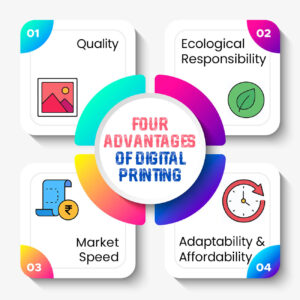
As the manufacturing sector embraces digital transformation methods to make, boost agility, and improve efficiency, it should come as no surprise that digitization has taken hold. The manufacturing landscape has changed as a result of recent events, compelling companies to reevaluate and think about how technology might enhance workflows and increase supply chain resilience. In the packaging sector, Konica Minolta has found four advantages of digital printing.

1. Quality – For short runs that require a quick turnaround without sacrificing quality, digital printing is perfect. There is no denying the significance of packaging and labeling in the manufacturing sector. Customized packaging and related product labels can stand out, boost brand awareness and loyalty, enhance market demand, and establish a personal connection with customers. Manufacturers must take into account not just the hardware but also the software and the capacity to create original apps that work together to offer better outcomes when selecting the best solution.2.

2. Ecological Responsibility– Nowadays, sustainability is a competitive advantage that can help you stand out from the competition. Customers are frequently willing to pay more for ecological products and packaging, which they are expecting more and more. Compared to traditional printing methods, digital printing has a smaller carbon footprint, requires less energy, and produces a lot less waste. Manufacturers who embrace ustainable production and lessen their environmental impact are likely to see a rise in sales, a boost to their reputation and brand, and an increase in customer trust.

3. Adaptability and affordability– Since digital printing requires almost no press setup and no printing plates, it is a cost-effective option for short runs. By lowering inventory costs and risk through on-demand printing, it also adds value for producers. Because of its adaptability, digital printing is perfect for manufacturers growing their product lines because it allows them to tailor their prints to customer demand while reducing the expenses related to SKU proliferation. Its capacity for flexibility is a major factor in producing a revenue stream that broadens current products and may open up new business opportunities.

4. Market speed– Because digital printing files are recognized by the printer instead of offset printing plates, it is more cost-effective to generate variable output and small runs. The time it takes to go from the design concept to the final product is therefore accelerated by digital printing. This eases supply chain problems, lowers overall costs, and enables businesses to react swiftly to consumer requests.

Promoting achievement in the packaging sector

Digital Printing

Digital printing is now a crucial component of company expansion and a way to set oneself apart from rivals in the consumer packaged goods sector. Given the anticipated exponential growth, the moment has come to review present procedures and leverage cutting-edge printing technology to release value that has been imprisoned. The demanding nature of the manufacturing sector is something we at Konica Minolta are aware of. We deliver exceptional flexibility, exceptional quality, and unique digital printing solutions to help manufacturers succeed in the cutthroat industrial market of today.

AccurioLabel 230 is compatible with a wide range of media including not only ordinary and matte paper, but also glossy paper, tack paper and film essential for label production. The user can not only select the ideal media to match applications but also print labels without the need for preprocessing. , the AccurioJet KM-1e, B2+ inkjet press’s production quality has improved. Skin tones, consistency of solid backdrops, and texture replication are among them, along with “best in the industry” image quality. Digital package printing, photobooks, and artbooks are a few specialized areas that the new model can be used in.


Digital printing makes it incredibly simple to invest in and diversify your business. Get in touch with the Konica Minolta team right now to take advantage of cutting-edge solutions for the packaging, label printing, and commercial markets.

digital trend

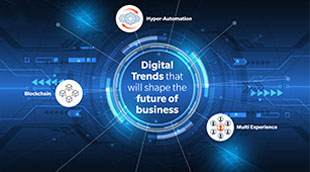
3 Digital Trends that will shape the future of business

Link

Hyper-Automation

Technology, the bedrock of the modern era, has forever been changing, inventing, and reinventing itself each day to make human lives better and simplified. Modern technology has paved the way for consumers to help make daily tasks like shopping, money transfer, and home security easy. Voice assistants like Alexa and Siri are also assisting consumers in setting daily reminders, reading out emails, and automating routine tasks like scheduling meetings and setting up conference calls.

Businesses are also harping on modern technology like cloud facilities for better file storage, RPA for automating menial, repetitive tasks, and machine learning to analyze and give creative solutions to daily activities.Tasks that earlier seemed unimaginable are now being undertaken by digital technologies daily to generate higher profits via optimum performance.

Let’s look at three technologies that Will Shape the Future of Business.

Hyper-Automation

Robotic process automation or RPA was an idea that humans can now promote to more critical business decisions, and programs can fulfill the menial tasks. Which was initially started as a way to perform low-level, repetitive tasks, based on rule-based processes has now, with the help of digital advancements, become the next breakthrough in technology. RPA now helps businesses with lubricating the supply chain, creating and maintaining better records in financial management, healthcare services, etc.

On the foundation of RPA, technology has now moved to Hyper-Automation. An ingenious fusion of RPA along with AI and machine learning will next shape the future of businesses. Hyper-Automation is a technology that not only performs at optimum capacity like RPA but also analyses the problems at hand via machine learning and provides creative solutions via artificial intelligence, thus increasing productivity.

FedEx, Amazon, and Walmart are already harping on Hyper-automation to streamline their business processes, reduce human error, and perform at optimum capacity. Hyper-automation helps these companies with stocking shipments systematically, reducing the process flow in supply-chain and also understanding the desired amount of time to perform a particular task, accordingly improving job allocation. Hyper-automation, in this way, has helped major companies sustain a workforce that functions at full capacity.

Blockchain

Technology is ever-evolving, inventing, and reinventing itself with each leap forward, yet a few advances can possibly change the whole world. One such leap forward is Blockchain technology.

Being completely secure and transparent in all its transactions, Blockchain is seen to have huge potential in the eyes of cryptocurrency corporations, but that’s not all. Because of the growing recognition of blockchain utilization, brands now realize its full potential for data transactions as well as business solutions.

Blockchain technology is already being applied for supply chain management in e-commerce. The healthcare industry is harvesting Blockchain to create transparent records, keeping a tap on the inventory, etc. Crowdfunding and global payments are far more secure. Music and content platforms can now make an end to end sale without the need for a middleman. The travel industry is leveraging on secure payments and better luggage tracking that Blockchain has to offer.

The transparency of Blockchain helps industries keep records that are full-proof and cannot be tampered with, unlike the internet, thus securing all our online transactions. Blockchain has changed the way the world now looks at cybersecurity, thus opening numerous avenues in the future.

Multi experience

Consumers purchase what they feel and not what they see, thus making experience equally crucial to the product, in the eyes of businesses. Multi-Experience, in one such effort to provide a personalized experience to digital consumers and also to train company employees, provide a better experience to offline consumers.

AR and VR, which were initially designed for the gaming industry, have now taken roots in the construction industry to create a simulation of the look and feel of the site before it is constructed.

Retail giants like Amazon and Walmart are harvesting on AR and VR to create virtual stores and train their employees for huge crowds at Black Friday sales. The retina moments captured by VR also help retailers understand which part of an aisle does the consumer capture first, which in exchange helps optimize product placements. In the right direction, AR and VR can shape the digital future of the world.

Machine learning and Artificial Intelligence are now helping businesses to create a personalized digital conversation with consumers to help create a human influence in the industry. Customer engagement via Conversational AI drives online sales revenue efficiently and helps resolve consumer queries and thus increases brand loyalty and goodwill.

It is needless to say that the world, as we know it, is changing rapidly. Technological breakthroughs open doors to future breakthroughs, and that’s how our technological advancement has been so far. Artificial intelligence, machine learning, RPA, hyper-automation, and multi-experience conversation is just the surface of the tip that technology has to offer. It’s not long before voice assistants will have a tangible physical body and will perform beyond programmed activities, where computers will be able to think for themselves and help better the world. Organizations will likewise keep tabs on ever-evolving technologies to advance into the realm of digital, and open a new world of possibilities for businesses.

digital transform

What does digital transformation mean for organisations?

Link

Digital Transformation

Digital transformation has spearheaded an era of revolution. Organisations are laying robust foundation on turnkey factors like business model, operational process and seamless execution. Especially, times when the data coming in, is overwhelming, it becomes mandatory to not only store the data, but, to secure it, from the lurking threats. Thus, this cultural shift from the manual process to the automated system, is what is being referred to as digital transformation.

An authoritative organ, of digital transformation, at a larger level, is analytics. While businesses tend to rely on analytics, to deliver enterprise value, the scope of analytics, goes beyond the listed tasks. A classic example of the usefulness of analytics being online-cab services and food-delivery apps. These online behemoths tend to deploy analytics to determine the price of the user’s ride or decode the ordering pattern of an individual. So the next time, an online app gauges your food preference, don’t be surprised! It is analytics, that has worked its magic across several verticals of the online business!

The centrifugal force though, something that combines all the important aspects of digitization and makes them work in sync with each other, is Omni-channel integration. As the name suggests, Omni-channel integration includes a multi-channel approach, towards optimization, marketing, selling and delivering a cohesive customer experience, after removing, the often-faced bottlenecks.

With the advent of the social media platforms, more and more businesses are investing heavily in this multi-channel integration process. Several big brands across industry have seriously taken up Omni-channel integration, to optimize the performance of their brand. A few instances listed below will certainly help us, when it comes to understanding the technical intricacies of Omni-channel integration.

A few reputed banks across industry, have set a dynamic example, for the world to follow. Their streamlined process makes way for scheduling an appointment, depositing a cheque and paying monthly bills, all without any hassle, via a desktop or a smart phone. As of yet, it might be difficult for customers to perform more complex functions such as getting a loan sanctioned. However, Omni-channel integration as a feature, has a long way to go.

A quick look at how differently a reputed coffee retail chain deploys Omni-channel for its business, will help us understand the essence of the feature. The rewards app, introduced by the brand allows a customer to avail free rewards, everytime, he or she makes a purchase at any of the outlets. However, unlike most traditional royalty programs, this brand allows its customers to reload and check their cards via desktop, mobile, in-store, website or the app. This further means, that any changes made to the card, will be updated in real-time, across all channels.

It also signifies, that even if the customer updates the card, while waiting in a line to get coffee, the cashier immediately gets to know about the update, by the time, the card is swiped. In a nutshell, it is the era of digital transformation, that has made this possible.

  • Enhanced Customer Experience.
  • Exploring new avenues of growth.
  • Maximising productivity.
  • Streamlining processes.
  • Creating new digital services and products.
  • Opening the floodgates to globalization.

The gamut of digital transformation comes with a host of benefits. A few of them, have been listed below:

Least to say, technology has come a long way, over the last decade. To add to it, we’re on the threshold of an era, where even smaller organisations will try to engage their customers directly, through different angles of digital transformation. On the flipside, with several organisations, still willing to implement the cutting-edge techniques, it isn’t hard to understand the reason behind the popularity it is gaining, across the globe!.

barcode

Barcode Recognition and Zonal OCR in a scan workflow

Barcode Recognition

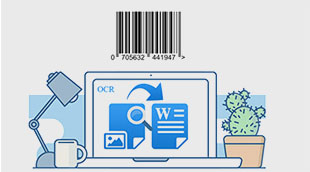
In today’s age of automation, scanning offers a great way to capture, store and manage information. Scanning non-digital sources (such as paper sheets or shopping bags made of fabric) can be straight forward – all one needs to do is hold them against a hand-held scanner or laser. Businesses and workplaces, however, may need to access and process information stored in non-physical (i.e. pre-scanned) forms as well, like PDF files and digital images.

To scan and decipher information from such sources, one obviously can’t use the afore-mentioned instruments. And printing them back to paper just to be able to scan them isn’t a smart answer. Thankfully, there are solutions in the market that offer a way out. Of them, two popular approaches are (built-in) Barcode Recognition and Zonal OCR technology.

Let’s look at each.

Barcode Recognition: Pros & Cons

Barcode Recognition Software – which belong to the larger family of data extraction software – can identify, translate and extract a range of information locked in PDF or image form. Advanced versions let you transfer the scanned and extracted data into a variety of file formats, turn the data manipulable (ie, index-able, searchable, editable & sharable), recognize characters even from partially damaged source files, customize extraction protocols and forward-integrate the extracted data seamlessly into workflows.

The downside is the reverse of this: In other words, regular versions may not carry the same versatility or offer the full suite of features.

Installing a Barcode Recognition Software into your hardware is easy. Once operational, they can process documents in large quantities (batches) – replacing manual data entry with reliable and automated workflows and saving the business substantial amounts of time, money and manpower.

Zonal OCR: Pros & Cons

Like Barcode Recognition, Zonal OCR’s also scan and read information (from PDF & image files) and convert them into index-able, searchable, editable & sharable digital formats. The big difference is that it allows one to extract information only from specified areas or ‘pre-defined data fields’, saving the time and cost of scanning the entire source document. Pre-defining the extraction zone can be as simple as drawing a box around it with a marker or stylus. What’s more, when data fields follow a consistent spatial pattern (as is quite often the case with receipts, vouchers and Purchase/Sales Orders), the system can be trained to focus only on those areas, streamlining things further.

Advanced Zonal OCR versions also let you scan and extract data from compound fields and custom-combinations (such as, say, a first name along with its corresponding pin-code and date). When you add this to their ability of processing large batches in one go, it translates into a fast, accurate and highly efficient way to automate data-entry or database creation.

What about the downside? Well, Zonal OCR works great when the source PDF or image has a set pattern. When the layout or structure of the source changes – thus shifting the location of the data field – Zonal OCR may falter. Clarity (such as resolution or blurriness) of the source image or PDF can also affect performance.

Both Barcode Recognition and Zonal OCR offer a smart route to automation in the workplace. By increasing speed, reducing errors, freeing up resources for more critical tasks and enabling better decisions, they can aid collaboration, amplify efficiency and boost ROI of businesses… manifold.

integrating

Benefits of integrating Paper with Digital Documents for successful automation

Digitally automated workplace

Be it smart apps, wearable tech or the cloud, the ‘future of work’ increasingly looks and smells like an automated one – in a digital kind of way. Hyper-connected and always-on technologies are expediting innovation in real-time. Virtual sync-ups, blurring the borders of office and home, are ushering better work-life balance. Knowledge sharing beyond natural workgroups is fostering collaborative growth cultures. From all angles, the ‘digitally automated workplace’ appears like a natural progression from a past that has been dominated by paper. The big question, however, remains:

Does automated mean paperless, or simply less paper?

At one end of the spectrum, the case for going 100% paper-free is growing shriller every day. From greater speed to highly efficient workflows to cost savings to easy shareability & access to accurate monitoring to environment friendliness, the advantages of this inevitable transition seems – at first glance – unimpeachable.

And yet, paper remains a reality in the modern workspace.

A little scratching-under-the-surface explains why. For one thing, the dicey nature of ‘cybersecurity’ (with virus and hackers a constant threat) is a big issue why companies cannot afford to put all their paper eggs in the digital automation basket just yet. A high initial Capex, long learning curves (and the human errors it accompanies) and the cost & complexities of building internal IT expertise all make a case for paper in their own way.

Perhaps the most powerful reason why the paper isn’t going anywhere soon is its psychological legacy: Society’s collective consciousness – and its various arterial processes – is still designed around, and dependent on, paper. Legal Documents & Wills still need to be signed with a pen- with a copy going to each party. A customer still feels uncomfortable walking away from a transaction without a paper receipt in hand. Vendors still raise paper invoices. Human nature, after all, is coded to trust something we can feel and touch – more than something that prides itself on being able to disappear into thin air (read cloud) at will.

integrating-Paper

So while teams and businesses can certainly stand to benefit from digital automation, it is important to appreciate that change takes time. And till that happens, the wise way out is to simply manage it better.

Reimagining workplace documentation and processes in a way that dovetails paper and machine equitably and intuitively is the best way forward

There are solutions available today that can be tailored to precise organizational requirements – no matter how unique. The first extract and capture data from a wide variety of paper inputs (such as invoices and challans) with the help of technologies such as multi-copiers, scanners, and OCR. The data collected is then converted into familiar and easy-to-use digital formats (such as MS-Word and MS-Excel) that enable rank-wide adoption and seeds an automation culture. In the final leg, the information is interpreted by mapping it to each step in the process, sequentially aligned to stakeholders involved, and distributed along the workflow.

A happy duality

With physical storage and retrieval systems becoming advanced, and with paper products such as notebooks and pens coming with built-in digital integration features (like auto-scanning or cloud), paper can happily co-exist with digital. As long as each can ‘read’ the other well and switch/interchange avatar according to need, this symbiotic dichotomy can bring integration, balance, and efficiency to the workplace.

Look at the paper and digital as two sides of the same coin, and the transformation to a 100% automated workplace becomes a lot more welcome.

Speed of paper

Is your organisation working at the ‘speed of paper’?

Link

speed of paper

The mass of incoming business information in an organisation is expected to grow 4.2* times the current volume in the next two years. What’s more, 60%* of this information is likely to be unstructured (like a conversation or an email) or semi-structured (like an invoice).

These figures should give you a pause, especially if you are in a department such as Legal, Finance or HR that faces an overwhelming number of documents, across multiple channels, every single day. If you are heavily reliant on paperwork, it’s time to get your business out of the box with enterprise class solutions that reduce paper handling and associated inefficiencies; and simultaneously improve office productivity and processes.

Curiously, more than 50%* enterprises view document automation as ‘highly important’’, and yet they struggle with document management. The question of what to adopt – i.e. DMS (Document Management System) or ECM (Enterprise Content Management) – adds to the confusion.

Let #BizOutOfTheBox set the record straight for you!

DMS is focused towards setting up a repository of documents within an enterprise. It is a software solution that allows users to scan, store, manage, share, track digital documents and is essentially geared at digitsation of documents. However, documents are generally stored in an unsearchable format and retrieval is an issue. DMS as a term has been slowly overtaken by ECM.

Organisation-working

ECM is no one single technology. Rather, it is a customised solution of strategies, tools and methodologies that fulfill an enterprise’s requirements – from capture, collection, data extraction and processing to storage and delivery of information; integrating collaboration and search capabilities every step of the way. In other words, it is an organisational process methodology. ECM allows management of large volumes of structured, semi-structured and unstructured data including electronic documents, images, web content, media files and emails.

ECM’s biggest strength is the integration of a robust search facility (with OCR) that can search both structured and unstructured data within documents. When you consider 18 minutes is the average time spent looking for a document in a paper heavy office, finding the file you need in seconds makes all the difference.

If any of the above resonated with you, then it’s time to get your #BizOutOfTheBox and consider robust enterprise content management systems such as e-bizVAULT and FingerTips. Both give you the assurance of best-in-class security as creators can maintain watertight rules to ensure the right people see the right documents at the right time.

* For all data points, refer the Intelligent Information Management (AIIM) website.

Back to Top