Author Archives: Konica Minolta

Makkar Copiers buys AccurioPress

-The new facility is part of the company’s vision to grow its footprint.

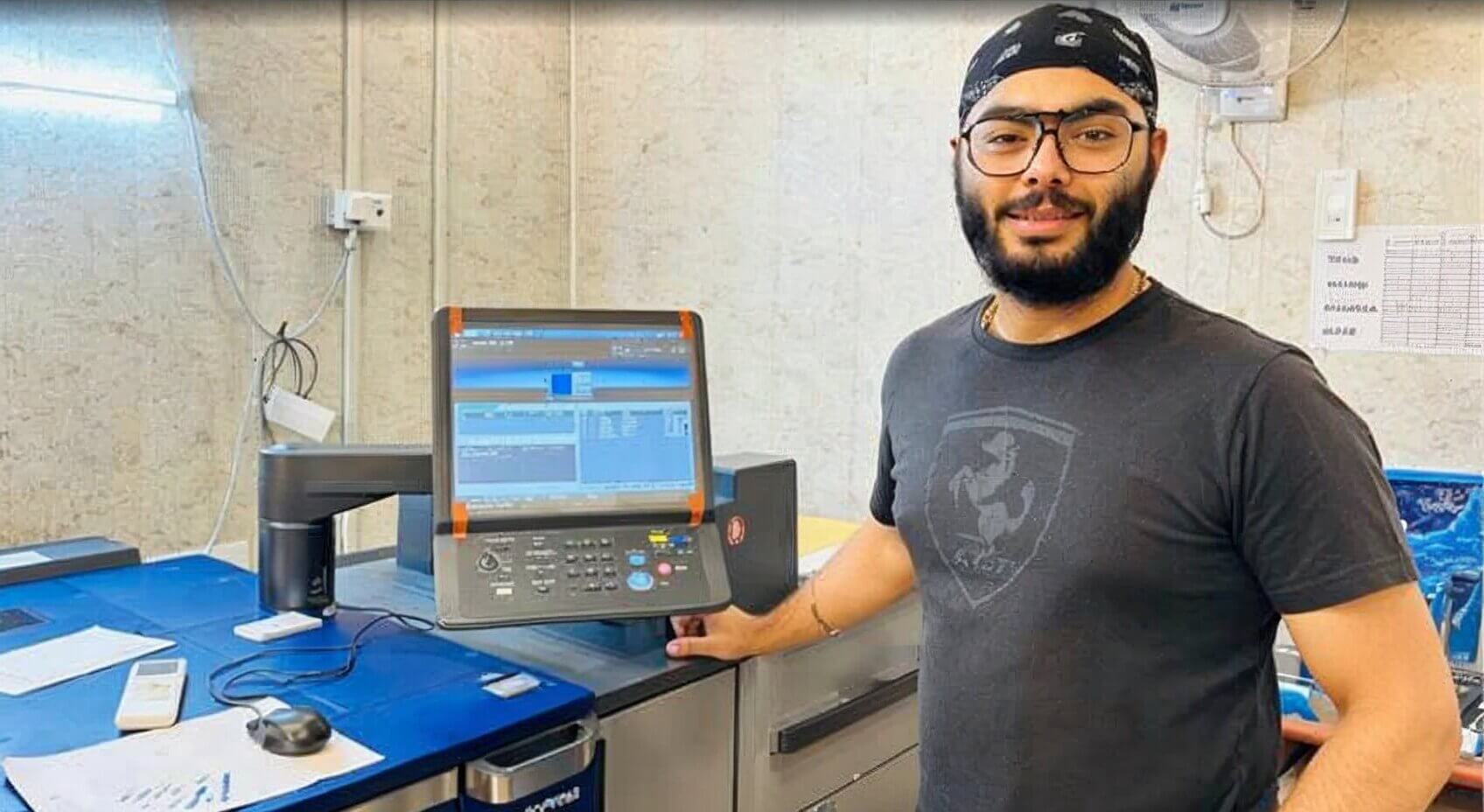
India, 06 June,2025: Konica Lucknow-based Makkar Copiers recently invested in a Konica Minolta AccurioPress C7100. The machine has been running at the company’s new unit at Aashiyana, Lucknow, which was established three months ago.

Baljeet Singh of Makkar Copiers said, “Initially, we had considered a Ricoh machine. However, having previously used Canon and Konica Minolta’s 1100 series at our other facility, we were thoroughly impressed by Konica Minolta’s service quality and machine performance. The immediate response and professionalism of the company’s engineering and service team made a strong impact. The support during installation and training was excellent. The Konica Minolta team patiently guided us through all our queries, ensuring a smooth onboarding process for the new equipment.”

In addition to the AccurioPress C7100, the company operates a ColorJet Flex machine for large-format printing, Canon photocopy machines, and a complete finishing setup including binding, hydraulic cutting, and lamination equipment. This holistic setup allows it to offer end-to-end print services.

Makkar

The company has a legacy of over 35 years, originally established by Singh’s father. “Inspired by his journey, I decided to carry the legacy forward and expand the operations. This led to the launch of a new unit in Aashiyana, Lucknow just three months ago. The new facility is part of our vision to grow our footprint and serve a wider customer base in the region,” he said.

The company caters to broker-driven business. However, since setting up its Aashiyana unit, it has gradually started attracting walk-in customers as well. “Our clientele spans various sectors, including hospitals, educational institutions, and local businesses. Our Flex machine also enables us to serve clients with large-format print needs, helping us diversify our offerings,” he said, adding, “We currently have a compact yet efficient team of seven employees handling different aspects of our operations.”

Though it’s only been a short while since the installation, Singh said the response has already exceeded his expectations. “The fact that we are the first to install the C7100 in this locality has sparked interest among customers and helped us stand out. The machine’s print quality and reliability have already begun translating into increased business. We are optimistic about achieving a strong return on investment in the coming months as more clients experience our enhanced capabilities,” he concluded.

Konica Minolta at Digital Print Asia Summit 2025

-Discussions on digital label and short-run production

India, 28 August,2025: Konica Minolta Business Solutions India, a leader in digital printing technologies, participated as the platinum exclusive sponsor of the inaugural Digital Print Asia Summit 2025, held on 21-22 August at the Novotel Jaipur Exhibition and Convention Centre, RIICO Industrial Area.

The partnership underscored the company’s commitment to advancing digital print innovation and strengthening industry collaboration. The association reflected the company’s ongoing mission to push the boundaries of digital printing innovation while nurturing deeper industry collaboration.

The summit, held under the theme “Where Innovation Meets Industry”, brought together more than 300 delegates from India and across Asia, including publishers, technology providers, packaging specialists, label converters, and media representatives. Over the two days, the event provided a platform for discussing transformative solutions shaping the future of digital print.

dpa-2025

“Digital Print Asia provided an excellent opportunity to engage with industry leaders, explore emerging market opportunities, and share our vision for the future of professional printing,” said Katsuhisa Asari, managing director, Konica Minolta Business Solutions India. “The response we received reinforces our commitment to helping customers achieve greater efficiency, quality, and sustainability in their print operations. As the industry continues to evolve, we remain dedicated to delivering innovative solutions that meet the changing needs of our partners.”

Konica Minolta participated in two sessions, with its Day 2 presentation centring on labels and packaging. The discussion resonated strongly with brand owners, converters, and print service providers, showcasing how digital printing can accelerate turnaround times, enable mass customization, and promote environmentally responsible production practices.

Seiji Nakashima, corporate vice president and division president of professional print business headquarters, Konica Minolta, in his address at the summit shared global perspectives on market trends and outlined the company’s strategic roadmap for advancing professional print technologies.

“The digital print landscape in Asia presents tremendous opportunities for innovation and growth,” said Nakashima. “Our focus is on delivering technologies that enable businesses to meet evolving customer demands while maintaining the highest standards of quality and sustainability.”

“Konica Minolta’s unique position in digital printing solutions made them an ideal Platinum Exclusive Sponsor for our summit,” said Tushar Dhote, co-chairman of Pamex and Bharat Print Expo, curator of Digital Print Asia. “Their participation enriched the discussions and provided valuable insights to our delegates on the
future of professional printing.”

RR Digital Mart invests in AccurioPress

-RR Digital Mart has recently invested in a Konica Minolta AccurioPress C7090.

India, 08 August,2025: Paramjit Singh of RR Digital Mart said, “We chose to invest in the Konica Minolta AccurioPress C7090 after comparing several machines in the market. We attended the PrintPack exhibition in Noida, where we evaluated print samples from multiple brands, including machines from Ricoh. Konica Minolta impressed us with its print quality and performance. After the installation, the Konica Minolta team provided complete support, including a thorough walkthrough of the machine. Our visit to the PrintPack exhibition also helped us understand the machine’s full capabilities before making the final decision.”

Currently, the Konica Minolta AccurioPress C7090 is the only digital press installed at RR Digital Mart. It is the core machine of its digital setup, handling the entire range of its digital print production.

RR Digital Mart in March 2025 as a dedicated digital printing company. Before launching this venture, the company was engaged in the offset printing business for over 25 years through its family-run operation started by Singh’s father.

RR-Digital

“Over time, we noticed a shift in client demands from high-volume offset printing to short-run, on-demand jobs. This prompted us to set up a separate digital unit to meet the evolving needs of the market. RR Digital Mart is an independent setup focused entirely on digital printing,” Singh said.

Singh brings more than two decades of experience in the printing industry. As the owner, he is directly involved in decision-making, operations, client relations, and strategic planning to ensure quality service and business growth.

“Our clientele includes walk-in customers from nearby towns and villages. Many of them have been associated with us since our offset printing days and have now transitioned to digital printing for smaller print runs. We work extensively with the education sector, providing college brochures, magazines, and academic materials. We also cater to local businesses looking for short-run jobs such as 500 copies or less. Our strength lies in offering reliable, efficient, and high-quality print solutions under one roof,” he said.

The current team consists of five to six people. Two members handle computer operations, and two manage the digital printing machines. The entire team is trained to work specifically in a digital environment, enabling us to operate efficiently and deliver consistent results.

Singh concluded, “Since we installed the machine just after the main printing season, we have not yet fully recovered our investment. However, we are already seeing positive results. We are generating around 2.5 lakh impressions per month without significant marketing efforts, primarily relying on our existing client base. With the upcoming season expected to bring higher demand, we are confident that we will recover our investment and potentially earn two to three times more soon.”

Dhairya Digital goes for AccurioPress

-Sonipat-based Dhairya Digital has recently invested in a Konica Minolta AccurioPress C7090.

India, 08 August,2025: Bhavya Sareen of Dhairya Digital said, “The decision to invest in the Konica Minolta AccurioPress C7090 was driven by the need to enhance production speed and overall efficiency. We had been using RC machines for an extended period, and the upgrade marked a strategic shift toward owning advanced, high-performing equipment. While formal training was not required due to our prior experience, the Konica Minolta team extended excellent support throughout the installation. We also received a comprehensive demonstration at the Konica Minolta demo centre, where the capabilities of the machine were clearly explained, particularly in terms of boosting productivity.”

Alongside the AccurioPress C7090, Dhairya Digital Prints operates a range of other machines sourced from Jindal Oxide. These include cutting machines, plotter cutting machines, and lamination machines. The in-house setup ensures that all finishing work can be completed under one roof, enabling faster turnaround and greater quality control.

Dhairya Digital Prints was established in 2019 with the vision of offering premium digital printing services. The company began its journey catering to specific niche segments, and over time, has developed a strong foothold in delivering high-quality, short-run print jobs. With a focus on precision, speed, and client satisfaction, the company has consistently evolved to meet the dynamic needs of the market.

Dhairya-Digital

Sareen is the proprietor and the key decision-maker at Dhairya Digital Prints. From inception, he has led the company single-handedly and continues to be deeply involved in all aspects of the business.

Dhairya Digital Prints primarily caters to two major client segments. The first includes manufacturers of wedding cards and wedding boxes, while the second segment comprises companies from the pharmaceutical industry. These clients rely heavily on precise, customised, and time-bound printing, which aligns with the firm’s operational strengths.

Currently, Dhairya Digital consists of four people, including Sareen. Despite the small size, the team is highly efficient and manages the entire production workflow in-house, covering pre-press, printing operations, and finishing tasks like cutting and lamination.

Since the installation of the AccurioPress C7090 is recent, just about a month ago and coincides with a relatively slow season, it is too early to make a definitive statement on returns. However, we anticipate gaining clearer insights into ROI over the next five to six months as production stabilises and client demand grows.

Businesses are finding it more and more crucial to adjust as the globe gradually shifts toward a more sustainable future. Sustainability is becoming an essential component of business rather than a “nice-to-have.” This change is especially apparent in the office printing industry, which has historically been linked to resource-intensive procedures.

Consumers are now more aware of how their purchases affect the environment and choose businesses that put sustainability first. Customers are drawn to and kept by a positive environmental reputation. Although incorporating sustainable practices into printing methods may appear difficult, it is completely doable with the correct approaches. Here are a few of these successful tactics:

1. Seek out environment conscious vendors

Office printing requires a variety of vendors, ranging from those who supply paper and ink to those who supply gear. It’s a difficult undertaking to make sure these vendors have and continuously maintain eco-friendly practices. However, the majority of suppliers are prepared to go above and beyond to obtain certification, given the growing desire to become an eco-friendly firm. Companies can check their suppliers’ certificates by visiting their website or by calling them.

2. Give careful printing top priority.

Printing is expensive and resource-intensive, and landfills and garbage can harm the environment. Establishing a culture where workers question whether they really need to print is a good way to promote sustainability. A double-confirmation system, which queues print requests and requires a special passcode or user authentication for confirmation, is another feature that some companies integrate into their printers. In addition to saving resources, this deters pointless printing.

3. Reduce trash to minimize recycling

Despite the importance of recycling, greenhouse gas emissions are still produced during the recycling process. The best course of action is to strive for waste reduction, which minimizes resource usage right from the start. The basic idea is to print only what is required, which minimizes the need for recycling and raw materials. For recycling and disposal, Konica Minolta separates its old packaging into multiple waste streams. For example, cardboard is recycled as usual, and polystyrene is crushed to create various diesel fuels. Additionally, it has been successful in increasing the post-consumer recycling (PCR) proportion of raw materials used to make toner containers to 40%, with plans to raise it to 100% in the future.

4. Make an excellent recycled paper investment.

Over time, recycled paper quality has significantly increased, providing companies with an environment beneficial substitute without sacrificing quality. Many varieties of recycled paper that are made especially for laser printers can be used with Konica Minolta bizhub devices.

5. Make the switch to paperless operations

Paper use can be considerably decreased by digitizing processes whenever feasible. Businesses and the environment both benefit from paperless operations, which save resources and improve organizational effectiveness.

6. Value and acknowledge green certificates

Green certifications offer verifiable evidence of a company’s dedication to sustainability. Obtaining these certifications improves a business’s standing and makes a strong statement about its commitment to environment friendly operations. By fulfilling multiple environmental certification requirements, such as the International ENERGY STAR rating, Blue Angel Mark, Forest Stewardship Council (FSC), ISO 14001:2004, Ethibel Sustainability Index, Eco-Mark’s EcoLeaf, and EPEAT 1, Konica Minolta demonstrates its dedication to sustainability.

All businesses are impacted by the shift to cloud computing and the internet. Web-2-print solutions are also necessary for small and medium printers to market their goods and services and stay competitive. This is due to the fact that more and more clients anticipate web-based services like online printing, e-business printing, and remote publishing. What distinguishes a contemporary web-to-print shop and what are the potentials of web-to-print?


For you as a print service provider, why is web-to-print so crucial? It allows you to lower expenses, boost productivity, and differentiate your services from those of your rivals, among many other benefits.

What benefits does web-to-print offer for commercial printing?
Both printers and their clients can benefit greatly from web-to-print shops.  They provide:

  • To boost sales, all print shop goods and services should have an online site.
  • 24/7 order access for customers
  • Ordering process transparency to cut down on customer support inquiries
  • Online payment methods that are integrated and enhance cash flow
  • Ordering, payment, and accounting process automation
  • Savings of time and money for customer marketing departments

The AccurioLabel and AccurioPro Flux Label Impose-related software are part of Konica Minolta’s label printing portfolio, which helps companies use automation and cutting-edge technology for more environmentally friendly labeling and packaging. Businesses can customize their printing on demand and cut expenses and waste with the AccurioLabel solution.

Blog6

What interfaces are necessary for a print shop to be future-proof?

Web-to-Print Store: Changes to systems are inevitable. They must be able to be linked into IT system landscapes and be flexible enough to adjust to the procedures that are currently in place in a print shop as well as those at the print shop’s clients. This means that in order to be future-proof, web-to-print shops must have interfaces that allow data to be instantly and economically exchanged with other systems. Interfaces that are helpful are:

  1. Prepress interface: This allows print data produced in the shop to be sent straight to the prepress process for data verification, ideally containing article details such format, paper type, finishing, print run, and delivery date. This interface should ideally be two-way. After that, the web-to-print system can initiate the proper follow-up procedures, e.g., sending a mail confirmation to the customer.
  2. Connect to clients’ eProcurement platforms, including Oracle, SAP, and Navision. Common standards for all communication channels are made possible by the bidirectional transmission of task information, which also streamlines the ordering and billing process.
  3.  An interface for web-based, automated contact with shipping and logistics service providers, such as for all pertinent order and shipping details.
  4.  Interface to payment systems: One of the most important success factors is the payment methods. Paypal and Klarna are two examples of common payment systems that need interfaces. You can offer direct debit, cash on delivery, and invoices from the web-to-print business without the need for an outside payment system. Your consumers’ preferred methods of payment are the deciding factor.
  5. Interface to factoring systems: Sales can be greatly boosted by offering the “purchase on account” option. can be greatly raised. putting in place a factoring structure to reduce the risk of nonpayment.
  6. Import interface for altering printed matter: Using design templates is a crucial feature for web-to-print firms that offer online printed matter design. This entails modifying graphic designs to allow for editing via the web-to-print technology.
  7. Image databases and image personalization: This interface allows the user to access and import external images. Interfaces that address PIM (Product Information Manager) and DAM (Digital Asset Manager) systems are utilized, for instance, in the business-to-business (B2B) setting.
  8. Marketplace: Connecting the web-to-print system to a marketplace may be beneficial, depending on the business model. -system to an industry. For instance, there are interfaces to Google and Amazon for this.
  9. CO2 calculator: Under sustainability objectives, it makes sense to offset the resources used in the climate-neutral manufacture of print goods. For this reason, the Web-to-Print system can provide a direct interface to a climate-neutral printing partner that determines the order’s CO2 emissions and manages the reimbursement through approved climate protection initiatives. approved climate protection initiatives.
  10. Interface to MIS/ERP: It offers APIs to import the process status back and permits the transfer of job and invoice data to a MIS/ERP system.

What kinds of online stores sell prints?

Limiting the online store makes logical based on the target audience. Consequently, a distinction is drawn between open shops and closed shops (also known as closed online portals).

Closed Stores
Businesses, organizations, public institutions, and industrial corporations are the target groups for closed shops. Closed stores are online portals that are exclusively accessible by specific user groups, such as regular customers. It is frequently possible to designate several sections for various clients, each with its own CD-compliant user interface and costs that are specifically stored.

Open Stores
The sale of printed materials and other products to a broad user base in the B2B and B2C sectors is made possible via an open online portal, also known as an Open Shop. Gaining new clients is made possible by this.
Web-to-print has immense potential. Print service companies can increase the variety of print products they offer, develop innovative online solutions, offer round-the-clock services like remote printing, and expedite order processing. Additionally, web-to-print automation helps internal print departments as well.

Learn how to maximize the performance of your web-to-printshop using Accurio Press hardware and AccurioPro Flux Ultimate software.

One Nevertheless, despite the industry’s consistent job growth, shifting consumer demands have created a great deal of disruption, leading many companies to think about incorporating inkjet technology into their digital transformation plans.

The printing market’s prospects

Shorter print runs, cutting-edge technology, and increased product personalization are all expected to shape the printing industry’s future. The global printing industry will spend the next ten years adapting to print buyers’ needs for shorter and faster print runs, according to Smithers’ 2021 market forecast. In addition to changing the dynamics of print costs, this will put further pressure on companies to automate their print manufacturing processes in order to boost profit margins and stay competitive.

Making the switch to an automated process can occasionally be expensive and time-consuming, but the investment is worthwhile. New machinery, such as digital (inkjet and toner) presses, will support the push for more variety in packaging print and assist companies in reducing run lengths. Higher output quality, quicker operating speeds, lower inventory overhead, and several financial advantages result from this.

The revolution of inkjet

Although there are a number of reasons for the growing interest in production inkjet technology for commonplace document applications, the primary forces behind its adoption are significant advancements in ink technology and pre-coat fluids as well as outdated business models that aren’t viable in the current environment.

The key to securing future business success is inkjet technology, which provides a number of features that unlock productivity and efficiency throughout the print production process. Additional advantages consist of:

Better quality: digital color toner presses are less efficient than high-speed inkjet technology. For instance, the high-speed inkjet technology from Konica Minolta can print at rated speed with a resolution of 1200 x 1200 dots per inch (DPI). Higher resolution and little to no warm-up time allow it to print smoother, finer details.

Excellent flexibility: Although flexible packaging accounts for a substantial portion of the packaging market, there are a number of issues with it, such as issues with food safety and de-inking capabilities. There is no requirement for specialized materials because inkjet technology can print on common offset print paper. Along with being suitable with a wide range of packaging materials and substrates, it also provides faster and easier customization than traditional off-set or toner-based print manufacturing.

High productivity: The high-speed UV LED inkjet technology from Konica Minolta can print 1,500 sheets per hour for perfecting and 3,000 sheets per hour for simplexing. By supplying information and quality at faster production speeds, this raises corporate productivity levels and makes the entire print process more cost-effective.

Revolution Of inkjet


Inkjet printing for commercial manufacturing is the way of the future.

Over the next ten years, the commercial print sector will be shaped by data-driven personalization, faster turnaround times, and lower run lengths. A key component of this future is production inkjet technology, whose development as a cutting-edge technology is raising the bar for the print industry’s efficiency, cost-effectiveness, and long-term success.

At Konica Minolta, we are aware of how difficult printing may be and how new technologies will influence future commercial success. We offer creative and distinctive solutions that offer exceptional flexibility, added value, and superior quality to make sure print firms prosper in a digital environment. Modern Konica Minolta print heads and sensing technologies are used in our ground-breaking UV LED inkjet technology, which offers the best speed and quality.

The commercial printing sector is changing quickly and moving steadily in the direction of more creative and effective solutions. More and more companies are implementing printing solutions that enable them to increase production without sacrificing cost effectiveness.
Digital printing solutions have become more popular as a result of technological improvements, giving companies of all sizes greater control over their printing requirements. Businesses may now print in more complex and creative ways because to digital printers’ ability to manage print runs across a variety of substrates, including folding cartons, pouches, pillow boxes, wooden packaging, and more. This is crucial for the e-commerce sector in order to produce visually appealing packaging that draws in customers.
The boom of e-commerce has led to a significant expansion in the field of digital label and package solutions (L&P). Companies want to be able to generate attractive labels and packaging whenever they need to. However, growing worries about sustainability and the environmental impact of complex packaging also hinder e-commerce enterprises and many others.

The argument in favor of environment friendly printing

Businesses are being forced to modify their operations and make investments in more ecologically friendly solutions as a result of the growing demand for sustainability in consumer behavior. Given the misconceptions about the paper-making process and its effects on the environment, such as the idea that paper is generated more from waste materials than from freshly cut trees, the printing sector as a whole is a major source of worry.

Both reality and public image are being improved by the growing use of sustainable, renewable, and recyclable materials as well as automation and digital printing technologies. According to the paper, because digital printing uses less energy and has a lower overall carbon footprint than outmoded, analogue printing processes, it offers a significantly more favorable solution.

DigitalPirnt

A few years ago, Konica Minolta introduced the IQ-501 (Intelligent Quality Optimiser) to solve waste caused by printing and setup problems. Owners and operators have benefited from this built-in technology as it speeds up setup and increases print efficiency.

According to the survey, digital printing solutions improve sustainability by producing less waste than its more conventional printing equivalents and lowering the need to store and store printed goods and raw materials. Furthermore, the ability to print on demand enables companies to guarantee that the designs they produce are up to date, removing the need for unnecessary, antiquated packaging that is either pulped or dumped in a landfill.

DigitalPrint

Konica Minolta has sustainability front-and-centre and is committed to evolving its digital printing ecosystem to deliver more sustainable and environment friendly solutions.

The AccurioLabel and AccurioPro Flux Label Impose-related software are part of Konica Minolta’s label printing portfolio, which helps companies use automation and cutting-edge technology for more environment friendly labeling and packaging. Businesses can customize their printing on demand and cut expenses and waste with the AccurioLabel solution.

Visit AccurioLabel 400 to learn more about how Konica Minolta and the AccurioLabel solution may assist you in providing your company with more environment friendly labeling and packaging.

Businesses that sell luxury or high-end products cannot afford for their marketing collateral to look anything other than spectacular. In addition to having outstanding writing, design, and photography, these organizations require printed materials that are distinctive in a crowded market. This gives commercial and industrial printers the chance to enhance the print tasks they do and opens new growth prospects.

Printed materials are still useful even though a large portion of marketing has moved to digital platforms. The noise produced by so much internet communication can actually be broken up by a well-printed document. Additionally, shorter print runs, customized marketing materials, and quicker work turnaround times are now feasible due to the growing popularity of digital printing.

Four strategies to make print jobs more valuable
Printers may increase their clientele, provide higher-quality work, and possibly even find new markets or revenue streams by adding value to print projects. Here are four strategies to make print more valuable:


1. Inkjet technique using UV LEDs
In addition to being ecologically friendly, UV LED inkjet technology dries incredibly quickly. Because of the quick turnaround times and the fact that inks don’t have time to bleed into the media, the final product is brighter and clearer and free of any flaws or waviness that could be brought on by heaters or dryers.

This is a cost-effective method because it can be printed on regular offset medium and eliminates the requirement for specialized materials. Additionally, short-turnaround assignments become much more feasible with machines that can print 3,000 sheets per hour simplex and 1,500 sheets per hour perfection.

Additionally, inkjet technology provides all the advantages of digital printing, including high productivity, workflow automation, personalization, and agility. Additionally, it enables printers to provide more cheap short-run tasks in greater number. This makes it perfect for books, periodicals, marketing materials, direct mail, and more.

Prints Job


2. Using foils and coatings for embellishment 
Products can be made to stand out by embellishing prints with foils and other coatings, particularly on labels or marketing materials. This evokes a feeling of elegance and quality through a tactile and visually striking experience. Digital finishing, such as heightened effects and foil, can significantly increase value.

Selecting a press that can decorate across a variety of surfaces and toner, inkjet, and offset prints is crucial. Spot gloss, three-dimensional printing, and metallic effects may now be achieved by printers

at a fraction of the time and expense of earlier methods thanks to new haptic, digital varnish technology. An average brochure, label, or mailer can be instantly transformed into something more captivating by adding these decorations and unique touches.

Customers find digital varnish technology to be a very appealing alternative due to its great productivity and quick turnaround, even for intricate embellishments. Additionally, because of the high-end output, printers are able to charge more for these services.

3. Printing at high resolution on the majority of substrates.
For high-value printing, presses with real 1,200 x 1,200 dots per inch (DPI) resolution are perfect because they guarantee accurate reproduction of even tiny text. You can offer countless innovative print applications with a press that has built-in technology to help create a wide color gamut. Additionally, being able to print on a variety of substrates can add value for customers with particular needs. By doing this, printers may be able to reach new customers by providing greater choice and variety.

4. Printing and finalizing labels
Customers also benefit from the ability to provide economical and effective label printing and finishing. It allows printers to serve as a one-stop shop and increase their portion of the customer’s budget by eliminating the need for them to visit several printers for their different needs.

Modern industrial label presses provide flexibility and great productivity by combining intelligent software with effective hardware to produce excellent quality. Adding label printing and finishing to their product line might help printers draw in more clients and possibly increase their profit margins.

The ideal press for the position 
Our goal at Konica Minolta is to assist commercial and industrial printers in increasing their profit margins, creating new sources of income, and taking advantage of new opportunities. Konica Minolta helps printers provide value for their clients, embrace the newest technologies for better results, and optimize workflows for increased efficiency with industry-leading presses that provide outstanding return on investment (ROI).

AI will eventually streamline an increasing amount of human labor, such as verifying print output systems. All things considered, AI makes employment safer and more effective. Additionally, there is a lot of room for cost reductions when it comes to purchasing production and professional print materials. What does AI already do for print shops now, and what are the potential future developments?

A Definition of Artificial Intelligence, Machine Learning, and Deep Learning

All three phrases are actually linked.

Machine learning and deep learning techniques are used to create artificial intelligence. The ability of robots to learn and adapt without human assistance is what gives them the appearance of “intelligence.” Although the fundamentals are not new, a new science has emerged as a result of increased access to big data sets and declining high-performance computing costs. Artificial intelligence is mostly influenced by two sources:

Algorithms are used in machine learning to “learn” from data, including photographs. In order to categorize subsequent photos at a higher volume, machine learning typically requires human interaction through manual tagging of sample images. A model is created to forecast the possibility of an image match from a data feed after a human annotates photographs so that the computer can identify important aspects. Analyzing the contents of a complicated visual scene or facial recognition are two instances of the application of machine learning. A relatively modest data set can be quickly transformed into a data model using machine learning.

A subset of machine learning is called deep learning. Essentially, deep learning creates the identification model automatically rather than requiring human interaction to tag data in order to identify text, voice, or image features. Building the models takes a lot longer and calls for considerably larger data sets. “Neural networks,” which are designed to replicate how humans learn and adjust to new information, are frequently used. Deep learning is capable of identifying tasks in addition to data items like photos. For this reason, this technology becomes crucial for operations that involve a lot of processes. Intelligent automation of software systems and physical systems, like robot arms, is possible for the tasks that are a part of daily operations.

Starting with fundamental intelligence for print operations, Konica Minolta employs all three components in different degrees of intelligence and sophistication throughout its range.


The advantages of AI for print companies
Manufacturing workers’ lives are being made easier by AI, which is now being utilized to make the working and manufacturing environment safer and more dependable.

By automating processes, AI helps print firms save labor expenses. AI also makes it possible to plan resources more effectively and accomplish sustainability objectives more successfully. More remote control capabilities and round-the-clock operation for improved press utilization, together with well-planned maintenance, will be available to printers.

Sensible fixes from Konica Minolta 

DeepLeaning

Intelligent algorithms that minimize print waste during the production print process and identify various document layouts. Customized mailings with varying content based on a customer’s profile can be automatically generated for direct mail and catalogs. This method is less prone to errors and more efficient thanks to AI. Because intelligent software can keep track of which presses are busy and which are not, it can route new jobs to available presses directly when it comes to job submission. Self-monitoring presses use a variety of sensors to continuously check on themselves. Algorithms can make real-time adjustments based on data, such as adjusting image quality and paper orientation. Without human involvement, the output is the finest print quality imaginable.

Konica Minolta can receive press operational data immediately. Using tools and algorithms, specialized experts will analyze press data and compare it to the anticipated performance. After that, a technician can determine and suggest software modifications or updates. Even before there is a service outage or disruption, predictive analytics can detect service requirements and start maintenance.

With robust and automated adjustments for image position, registration, and absolute color control—including hybrid color measurement and real-time correction for print output—Konica Minolta’s Intelligent Quality Care (IQ-501) saves time during printing. You can quickly build new and varied print goods with Intelligent Quality Care.

Additionally, issues with individual print jobs can be automatically detected and fixed while printing is underway, eliminating the need for human intervention. This addition greatly streamlines the printing process.


Prospects for AI in Production Printing 

The evaluation of an object’s output quality, especially that of its surface or edge, is the next domain in which artificial intelligence is used. For instance, camera technology linked to a quality inspection system can evaluate the accuracy of cuts made during the post-printing process. Here, artificial intelligence (AI) can be used and learn continuously, replacing some of the manual chores that people perform, freeing them up to work on more lucrative projects.

The manipulation of materials by networked robots is another example of the future. AI may, for instance, determine how long a print job will take and how much paper will be used, and then schedule reloading appropriately, transporting the appropriate supplies from a store to the machine’s side for human handling. Robots are being studied for in-line paper loading; the primary difficulty is precise alignment with huge printer loading bays.

A third field is the application of artificial intelligence (AI) such as ChatGPT to enhance communication and, for instance, swiftly access and utilize technical knowledge currently found in manuals and documentation. Today, Konica Minolta is able to offer its clients increasingly advanced AI technology. Hardware for the IQ-501 Intelligent Quality Care solution’s automatic quality inspection and correction features as well as AI systems linked by the Internet of Things, including industry-standard collaborative robot arms, are examples of solutions. Additionally, camera systems can automatically analyze environmental factors like heat or moisture and monitor workplace health and safety hazards brought on by people, equipment, or environmental factors

These IoT technologies can also be combined by Konica Minolta to produce fresh, useful information for the printing sector and production printing settings. As an end-to-end solution, we are also focusing on combining prepress, press, and postpress technologies. Connecting the dots to minimize manual touchpoints in accordance with Industry 5.0 principles is our goal.

  • Safer places to work
  • A more dependable manufacturing setting
  • Better, automated decision-making through the integration of data from several sources
  • Quicker decision-making
  • Error reduction
  • Automated procurement that lowers costs
  • Improved scheduling and resource management
  • More environmentally friendly printing
  • Reduced personnel expenses
  • Increased use of the press

By combining prepress, press, and post press into a single system that functions well together and can be managed by automated decision-making processes like AI and ERP systems, our customers can open a whole new chapter of inline capabilities in production printing and industrial printing with Konica Minolta.