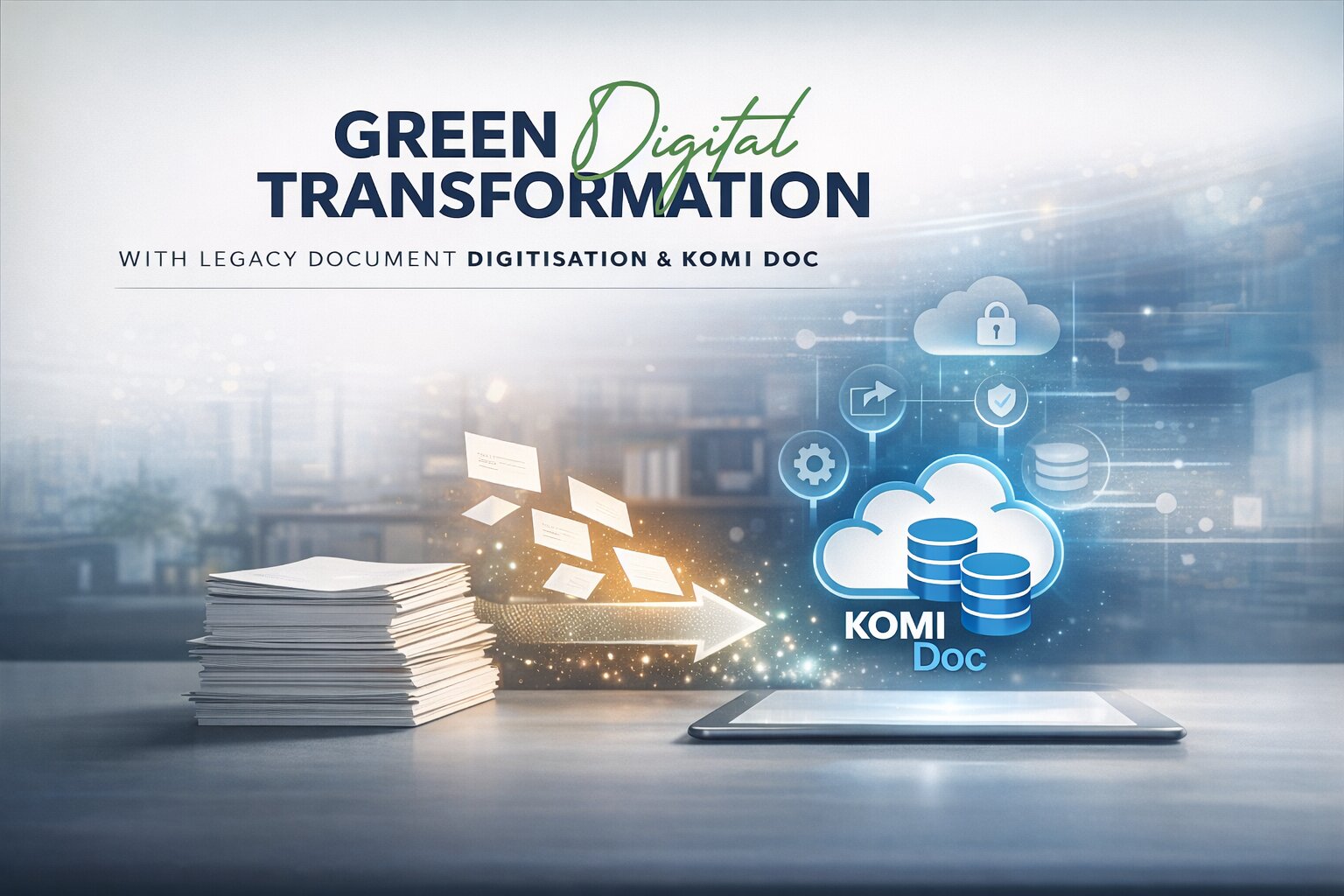



For many enterprises, legacy paper records are a silent burden. Contracts stored in cupboards, HR files boxed in storage rooms, and finance documents archived offsite still hold business value—but remain difficult to access, manage, and govern.
As organizations accelerate digital transformation, legacy paper records often become the biggest obstacle. Digitizing legacy records is no longer about freeing physical space. It is about unlocking information value, strengthening compliance, and enabling faster, more efficient operations.
– Why Do Legacy Paper Records Still Exist in Enterprises?
Legacy records persist because paper was the default business medium for decades. Regulatory retention requirements, traditional approval workflows, and historical record-keeping practices all contributed to the accumulation of physical archives.
Many enterprises delay action because digitization feels complex—large volumes, mixed document types, and data security concerns often slow progress. As a result, paper continues to coexist with digital systems, creating fragmented processes and information silos.
Yet these documents remain critical for audits, legal matters, historical reference, and operational decision-making.
– What Risks Do Legacy Paper Records Create for the Business?
When important documents remain in physical form, enterprises face increasing risk.
Paper records are vulnerable to loss, damage, unauthorized access, and misfiling. Retrieving a single document can take hours or days, especially when archives are distributed across locations. These delays directly impact productivity and audit readiness.
Manual handling also increases error rates. Missing pages, outdated versions, or misplaced files can lead to serious legal, financial, and compliance consequences.
– What Does Digitizing Legacy Records Really Mean?
Digitizing legacy records goes far beyond scanning paper into PDFs.
True digitization transforms physical documents into searchable, indexed, governed digital content. Documents are captured, enriched with metadata, secured with access controls, and managed throughout their lifecycle.
The goal is to ensure that historical records become actively usable business assets, fully integrated into modern workflows rather than locked away in archives.
– How Does the Legacy Record Digitization Process Work?
Most enterprises follow a phased, structured approach:
1. Assessment & prioritization
Records are evaluated based on business value, access frequency, and regulatory requirements.
2. Scanning and digital capture
Physical documents are converted into digital files using OCR for full text searchability.
3. Indexing and metadata tagging
Documents are categorized by type, department, date, reference number, or compliance class.
4. Secure storage and governance
Records are stored in centralized repositories with retention rules, access controls, and audit trails.
– How Do Digitized Records Improve Day-to-Day Operations?
Once legacy records are digitized and centrally managed, operational efficiency improves immediately.
Employees can retrieve documents instantly without leaving their desks or submitting storage requests. Distributed teams gain equal access, supporting hybrid and remote work models.
Digitized records also enable real-time collaboration, version control, and faster decision-making across finance, HR, legal, and operations.
– How Does Digitizing Legacy Records Support Compliance and Audit Readiness?
Compliance is one of the strongest drivers for digitization.
Digital systems automatically maintain audit trails, access logs, and version histories. Enterprises can quickly demonstrate who accessed a document, when changes occurred, and whether retention policies were followed.
Instead of scrambling through boxes during audits, organizations can respond confidently with structured, searchable digital evidence.
– Why Is Managed Content Services Better Than Handling Digitization Internally?
Digitizing large volumes of legacy records in-house requires specialized equipment, trained staff, secure handling processes, and long-term governance expertise.
Managed Content Services (MCS) take a lifecycle-driven approach—covering assessment, digitization, indexing, storage, security, compliance, and optimization.
This reduces internal strain, ensures consistency, and allows teams to focus on core business priorities rather than managing complex digitization projects.
– How Do Managed Content Services Deliver Long-Term Value?
Managed Content Services are not a one-time clean-up exercise.
Digitized records become embedded within enterprise workflows, approvals, and reporting systems. Retention rules prevent future backlogs, while security controls protect sensitive information over time.
As new documents enter the organization, the same governance framework applies—preventing paper accumulation from recurring.
– How Does Print-to-Digital Convergence Support Legacy Digitization?
Paper does not disappear overnight. Even digitally mature enterprises continue to receive physical documents.
Print-to-digital convergence connects multifunction devices directly to digital repositories and workflows. Documents are captured at entry, indexed automatically, and governed consistently.
This ensures legacy digitization and ongoing document capture operate as one continuous, controlled content ecosystem.
– How Can Konica Minolta Help Digitize Legacy Records?
Konica Minolta supports enterprises through Managed Content Services that simplify and accelerate legacy record digitization.
By combining large-scale document digitization with
Enterprise Content Management (ECM), Konica Minolta converts physical archives into searchable, secure digital repositories governed by defined access and retention policies.
Solutions such as KOMI Doc enable organizations to manage legacy records alongside daily operational documents—supporting workflows, approvals, electronic signatures, audit trails, and compliance from a unified, cloud-ready platform.
Most importantly, Konica Minolta enables a start-small, scale-smart approach, helping enterprises move from legacy digitization to broader digital transformation without disruption.
– Table: Paper Archives vs Digitized Legacy Records
| Aspect | Paper-Based Legacy Records | Digitized & Managed Records |
|---|---|---|
| Accessibility | Manual, slow, location-dependent | Instant, remote, searchable |
| Security | Physical access risk | Role-based digital access |
| Audit Readiness | Time-consuming, error-prone | Audit trails & logs |
| Storage Cost | High (space & offsite storage) | Lower, scalable |
| Collaboration | Single-user, physical | Multi-user, real-time |
| Compliance Control | Manual enforcement | Automated retention rules |
FAQ
We have offices in different cities need print infrastructure optimization services for multi location business. Any suggestions?
Distributed archives create delays and compliance risk. Konica Minolta India supports multi-location businesses by standardizing document capture, digitizing legacy records, and storing them in centralized, governed repositories—ensuring consistent access and control across cities and offices.
Konica Minolta vs Xerox vs Canon managed print services which better for mid size business?
For mid-size businesses, the differentiator lies in how print services support digitization. Konica Minolta India focuses on integrating managed print services with legacy record digitization, workflow automation, and enterprise content management—helping organizations transition from paper-heavy environments to structured digital operations.
What are the main problems with managed print service contracts for businesses?
Traditional managed print contracts often focus only on volumes and devices. This approach does not address legacy archives, compliance risk, or information silos. The blog highlights the need for managed services that include digitization, indexing, governance, and lifecycle management—areas addressed through Konica Minolta India’s Managed Content Services.
Are digitized records legally compliant?
Yes. When managed correctly with audit trails, access controls, and retention policies, digitized records meet regulatory and legal standards.
Why should enterprises use Managed Content Services?
Managed Content Services provide expertise, scalability, security, and lifecycle governance—reducing risk and internal workload while delivering faster results.